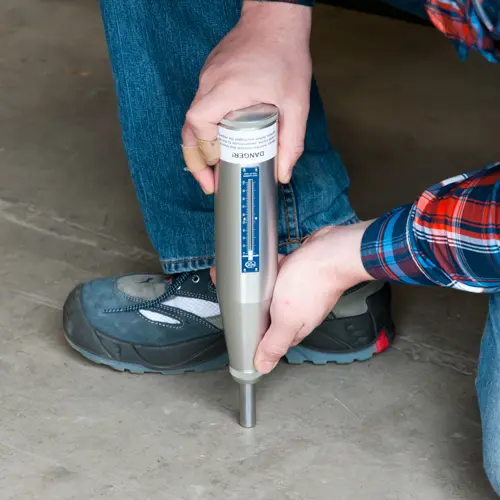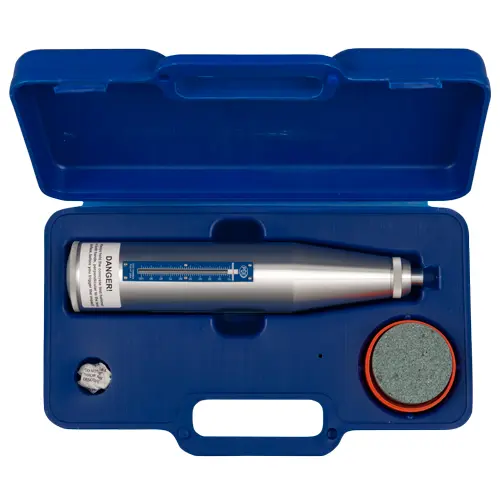




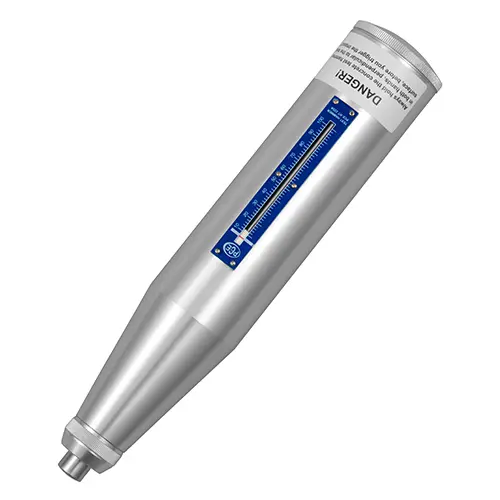
The easy-to-use impact tester is primarily used in the construction sector and other industrial sectors (checking the hardness of goods in rolls...). This impact tester for checking concrete is based on the Schmidt principle. The test is always performed under the same test energy of 2207 J. The initial rebound kinetic energy is given in the impact tester as a measure of the hardness of the concrete, the pressure on the surface, or the compressive strength (kg/cm² or its conversion to N/mm²). The quality of the concrete is assessed based on its compressive strength, as it is a guiding value for checking the load-bearing capacity and durability of concrete constructions. The compressive strength is represented with a series of numbers and letters. For example: B 25 means that it is normal concrete with a compressive strength of 25 N/mm². There are different intermediate values up to the higher strength class B 55. With our impact tester, you can classify concrete easily, quickly, and accurately. The impact tester is factory calibrated, but an optional ISO calibration certificate can be requested (additional charge).
- Very solid construction.
- Special rebound body for performing innu-
measurable concrete checks
- Very easy handling
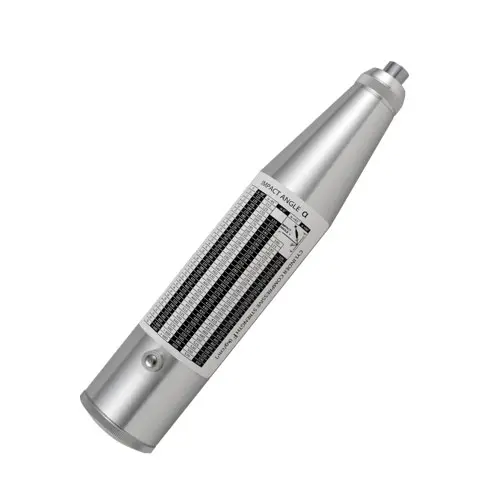
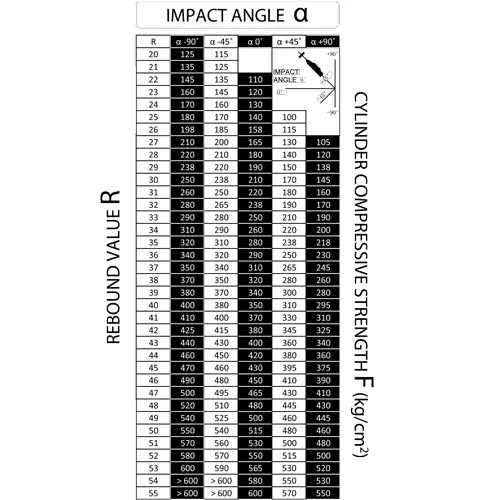
- Conversion table on the back
- Corrective aids for measurement results-
Edition in the user instructions
- Optional ISO calibration certificate
General information on pressure resistance in concrete
Pressure resistance is generally defined as the measurement of resistance to rupture when applying a pressure load on an axis for a short period of time. The pressure resistance of concrete is determined considering the influence of the following magnitudes:
Resistance of the cement block
- Composition and compaction of concrete
- Storage time and conditions
- Dimensions and shape of the test element
- Type and duration of the load
Pressure resistance is normally determined in the laboratory in concrete cubes or in straight circular cylinders. In the case of cylinders, once the excess concrete is removed, it is recommended to immediately establish a leveling layer that will often be necessary to obtain a smooth and flat pressure surface. The cylinders are constantly hardening. Since it is not practical to perform a check using laboratory methods, the impact meter shaped like a hammer is used, which is easy to handle and provides considerable accuracy.
Technical specifications
Measurement ranges
100 ... 600 kg/cm² (~ 9,81 ... 58,9 N/mm²)
Accuracy
±18 kg/cm² (~ ±1,8 N/mm²)
Percussive energy
2207 J
Measurement indicator on the front scale
0 ... 100 (sin dimensiones)
Scale for pressure resistance
at the back
To convert dimensionless indicator values to kg/cm² (with angle input)
Correction table for measurement values
In the operating instructions
Maximum concrete thickness (of the material)
70 cm
Dimensions
Diameter of 66 x 280 mm.
Peso
1 kg
Contents of the shipment
1 x Impact Tester PCE-HT-225A (Schmidt method)
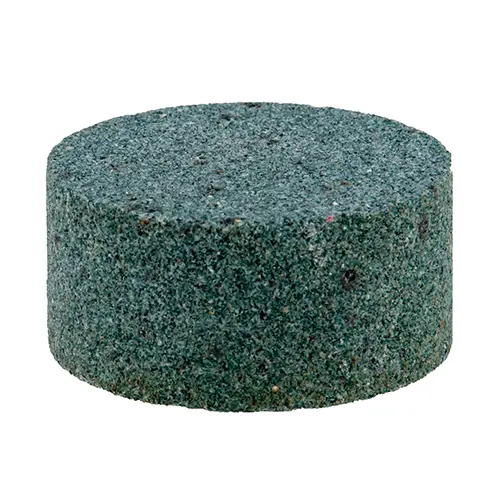
1 x Round grinding bar
1 x Wooden transport case
1 x User manual
More information:
Recommendation:
Metrological calibration certificate of:
Technical service and maintenance of:
Impact tester
Impact tester
International calibration certificate:
220 US$
Preventive maintenance and verification:
35 US$
Calibration certificate from EQUINLAB SAC calibration laboratory - Standard 17025
50 US$
Repair, corrective maintenance, adjustment, update, and validation:
60 US$
Includes:
** 2-year warranty.
** Discounts for the sale of two or moreImpact tester.
** Metrological calibration certificate for Impact tester.
** Preventive maintenance, corrective (repair), technical service, and spare parts.
** Sales, maintenance, calibration, certification, and technical service 24 hours.
Envios a:Argentina, Bolivia, Brasil, Chile, Colombia, Costa, Rica, Cuba, Ecuador, El Salvador, Guatemala, Honduras, Mexico, Nicaragua, Panama, Paraguay, Peru, Puerto Rico, Dominican Republic, Uruguay, Venezuela.