



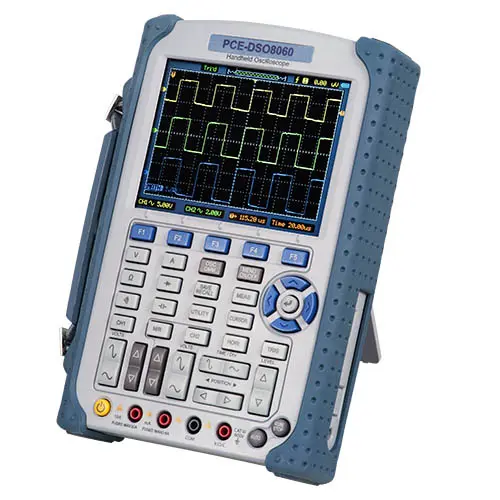
handheld oscilloscope with multimeter and function generator / 5.7" color TFT display / FFT analysis / high measurement rate / USB port / lithium-ion battery
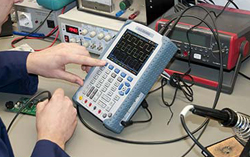
The PCE-DS08060 oscilloscope integrates 3 meters in 1. In addition to being an oscilloscope, it integrates a multimeter and a function generator. The PCE-DSO8060 oscilloscope has been specially designed for mobile use. The large LCD screen of the oscilloscope, which integrates LED lighting, is easy to read, even when sunlight illuminates the screen. A handle located on one side of the oscilloscope allows this measuring instrument to be taken anywhere. The rubber protection prevents damage to the casing during transport or handling of the oscilloscope. This user-friendly oscilloscope offers performance similar to bench devices. The oscilloscope has a bandwidth of up to 60 MHz and a sampling rate of up to 150 MS/s. In addition to the simple measurement of all parameters of the incoming signals, the oscilloscope performs an FFT analysis. All settings of V/div, s/div, or signal trigger are made through the rubber buttons of the oscilloscope. The two input channels of the PCE-DSO8060 oscilloscope connect to the probes via BNC connectors. The probes included with the oscilloscope can be switched to a regulation factor of 1:1 or 10:1. The oscilloscope also allows selecting different operating modes. A simple button press allows the oscilloscope to become a digital multimeter with various functions, such as voltage or capacitance measurement. The connection of the test leads for the multimeter is made through 4 mm banana connectors located on the front of the oscilloscope. The built-in function generator of the PCE-DSO8060 oscilloscope simulates waveforms that the user can freely adjust. In fact, it generates sine waves, triangular waves, or rectangular waves. You can power the oscilloscope through a network component included in the shipment or through the built-in lithium-ion battery. The battery lasts approximately 6 hours in continuous operation. When using the oscilloscope with the battery, keep in mind that the screen turns off after a certain period of inactivity to extend battery life. Through one of the two USB ports, you can connect the oscilloscope to the computer to log measurement data. The second port allows the user to directly save the displayed images to a USB stick.
Handheld oscilloscope PCE-DSO8060
- Bandwidth 60 MHz
- 150 MSamples
- Maximum of 300 V in oscilloscope mode
- Alta sensibilidad
- Many mathematical functions
- Large LCD screen on the oscilloscope
- Integrated multimeter
- Function generator
Technical specifications of the handheld oscilloscope PCE-DSO8060
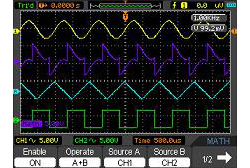
Here you can observe the mathematical functions of the PCE-DSO8060 oscilloscope
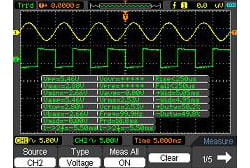
In addition to measurement curves, the oscilloscope can represent all parameters numerically.
Technical specifications of the multimeter function of the PCE-DSO8060 oscilloscope
Measurement range
Resolution
Accuracy
Direct current
60 mV
10 µV
±1 % ±1 digit
600 mV
100 µV
±1 % ±1 digit
6 V
1 mV
±1 % ±1 digit
60 V
10 mV
±1 % ±1 digit
600 V
100 mV
±1 % ±1 digit
800 V
1 V
±1 % ±1 digit
Alternating current
60 mV
10 µV
±1 % ±3 digits
600 mV
100 µV
±1 % ±3 digits
6 V
1 mV
±1 % ±3 digits
60 V
10 mV
±1 % ±3 digits
600 V
100 mV
±1 % ±3 digits
Corriente continua
60 mA
10 µA
±1.5 % ±1 digit
600 mA
100 µA
±1 % ±1 digit
6 A
1 mA
±1.5 % ±3 digits
10 A
10 mA
±1.5 % ±3 digits
Corriente alterna
60 mA
10 µA
±1.5 % ±3 digits
600 mA
100 µA
±1 % ±1 digit
6 A
1 mA
±1.5 % ±3 digits
10 A
10 mA
±1.5 % ±3 digits
Resistencia
600 Ω
0,1 Ω
±1 % ±3 digits
6 kΩ
1 Ω
±1 % ±1 digit
60 kΩ
10 Ω
±1 % ±1 digit
6 MΩ
100 Ω
±1 % ±1 digit
60 MΩ
1 kΩ
±1.5 % ±3 digits
Capacidad
40 nF
10 pF
±1 % ±1 digit
400 nF
100 pF
±1 % ±1 digit
4 µF
1 nF
±1 % ±1 digit
40 µF
10 nF
±1 % ±1 digit
400 µF
100 nF
±1 % ±1 digit
Aviso: The minimum measurable capacitance value with the oscilloscope is 5 nF
Diode test
0 ... 2 V
Continuity test
< 30 Ω
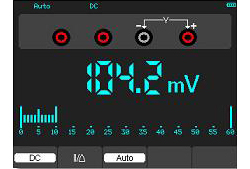
The PCE-DSO8060 oscilloscope offers the possibility to use this device as a multimeter. This oscilloscope is capable of measuring voltage, current, resistance, capacitance, and other parameters. The display occurs through the large LCD screen. In addition to the numerical value, a bar graph is displayed on the oscilloscope for value orientation within the measurement range. It also informs the user which socket to connect the test leads to.
Technical specifications of the function generator of the PCE-DSO8060 oscilloscope
Frequency range
1 Hz (DC) - 25 MHz
Frequency resolution
0,1 %
Digital timer / analog converter
2 kHz ... 200 MHz
Output channels
un canal
Memoria
4 KSamples
Vertical resolution
12 bits
Estabilidad
< 30 ppm
Amplitud
max. ± 3.5 V
Output impedance
50 Ω
Output current
50 mA Is= 100 mA
The built-in function generator in the PCE-DSO8060 oscilloscope allows output through one channel and simulation of different waveforms. The oscilloscope is capable of simulating sine, triangular, square, pulse, or edge output signals. The user can freely select the frequency and amplitude. In addition to simple signal output, various modulations and signal modifications can be performed on the oscilloscope.
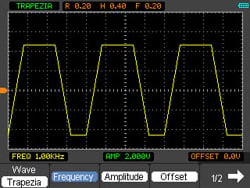
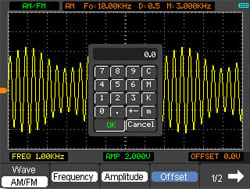
The extensive menu of the oscilloscope allows for quick and easy adjustment of the function generator. With the help of a numeric keypad, it is possible to directly adjust all parameters such as output frequency and output voltage. Using the oscilloscope as a function generator allows for fast and, above all, precise work. In the attached image, you can observe the frequency adjustment and the amplitude of a waveform with FM modulation, made through the numeric keypad as described above.
General specifications of the PCE-DSO8060 oscilloscope
Pantalla
5.7" LCD with LED lighting
Screen resolution
240 x 230 pixels
Interfaces
USB (oscilloscope <-> USB stick)
USB (osciloscopio <-> ordenador)
Power supply
external network component:
Entrada: 100 V ... 240 V AC / 50 Hz ... 60 Hz
Output: 8,5 V / 1500 mA
acumulador ion-litio integrado:
Approx. operational duration 6 h
Dimensions of the oscilloscope
245 x 163 x 52 mm
Peso
1200 g
The PCE-DSO8060 oscilloscope was designed for quick and easy use. This oscilloscope has its application scope in the laboratory and workshop. Thanks to the integration of extensive functions such as multimeter, function generator, and oscilloscope, the PCE-DSO8060 has a very versatile use. Its simple handling and large screen allow for quick operation without the user having to study the instruction manual extensively.
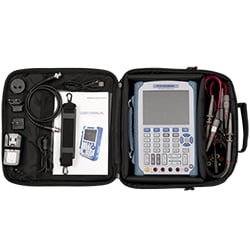
In addition to the oscilloscope itself with multimeter and function generator capabilities, test leads are included. The oscilloscope also comes with a power adapter, a convenient carrying bag, and extensive operating instructions. The carrying bag protects the oscilloscope during transport. Thanks to the three built-in functions in the PCE-DSO8060 oscilloscope, technicians will not have to carry three separate devices: an oscilloscope, a multimeter, and a function generator in their toolbox. This saves space and, above all, costs.
Contents of the PCE-DSO8060 oscilloscope shipment
1 x PCE-DSO8060 oscilloscope, 2 x probes for the PCE-DSO8060 oscilloscope,
2 x laboratory test leads, 1 x BNC connection cable, 1 x network component, 1 x lithium-ion battery, 1 x oscilloscope PCE-DSO8060 user manual, 1 x software
Operating principle of the digital oscilloscope with memory
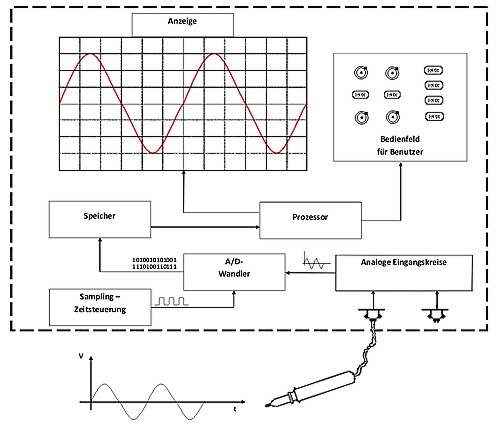
Oscilloscopes are used where it is necessary to visually represent electrical signals. The voltage over time is represented in a two-dimensional coordinate system. A digital oscilloscope with memory is composed as follows.
The signal collected by the probe tip is adjusted with the help of the analog input circuits (signal, amplifier, etc.). It is then sent to an A/D transducer. The A/D transducer is a component that transforms the analog input voltage into a digital numerical value. The signal is checked in a fixed cycle. The values are stored in memory. Using a processor, the values are read and displayed on the screen.
Some concepts of the oscilloscope
Sampling rate: The sampling rate indicates how many times the analog signal is checked or measured. It is usually indicated as the number of samples per second collected, e.g. 500 MS/s (Megasamples per second). The sampling rate determines how accurately the frequency of the input signal is displayed. For a good presentation, the sampling rate should be ten times the maximum input frequency.
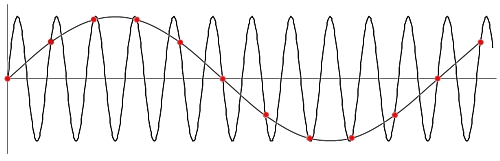
When checking a signal with a low sampling rate, aliasing occurs. This effect causes a waveform to be displayed with a multiple of the period of the actual signal. The following sketch illustrates this:
The red dots indicate sampling. From this, a low-frequency signal is incorrectly reconstructed. To avoid this, a low-pass filter can be used to filter frequencies that are above the average sampling frequency.
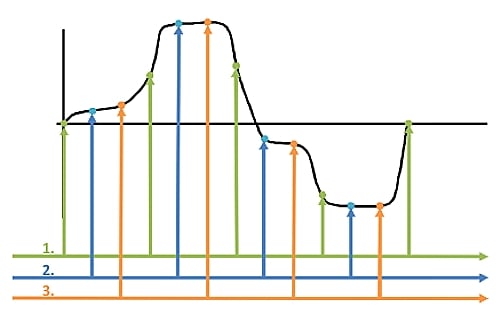
Measurement sequence (offset sampling): Through the measurement sequence, you can correctly reconstruct periodic signals with a low sampling rate. Each period is sampled several times. However, the sampling moments are offset relative to the start of the period.
After the first run (green), the signal is sampled several more times out of phase (blue and orange). This allows for accurate signal reconstruction despite having a low sampling rate. This process has the disadvantage that the signal must be periodic and repetitive. Unique and brief events cannot be recorded.
Trigger: If the oscilloscopes displayed the input signal from left to right, it would not be possible to generate a stopped image. Because the image frequency is usually very high and the signal would start from a random point, we would get a flickering image. To solve this problem, a trigger is used. This allows for a clear image, as it detects when the input signal exceeds the threshold value (this adjustment is done manually on the oscilloscope). As soon as a trigger event occurs, the input signal is displayed on the screen. This ensures that the signal is always shown starting from the same point. Many oscilloscopes offer an external trigger. This allows the start of the indication to be regulated through an external input. Modern digital oscilloscopes additionally offer other triggering possibilities.
Information:
Recommendation:
Metrological calibration certificate of:
Technical service and maintenance of:
Osciloscopio
Osciloscopio
International calibration certificate:
220 US$
Preventive maintenance and verification:
35 US$
Calibration certificate from EQUINLAB SAC calibration laboratory - Standard 17025
30 US$
Repair, corrective maintenance, adjustment, update, and validation:
60 US$
Includes:
** 2-year warranty.
** Discounts for the sale of two or more Osciloscopio.
** Metrological calibration certificate for Osciloscopio.
** Preventive maintenance, corrective (repair), technical service, and spare parts.
** Sales, maintenance, calibration, certification, and technical service 24 hours.
Envios a:Argentina, Bolivia, Brasil, Chile, Colombia, Costa, Rica, Cuba, Ecuador, El Salvador, Guatemala, Honduras, Mexico, Nicaragua, Panama, Paraguay, Peru, Puerto Rico, Dominican Republic, Uruguay, Venezuela.